Why Do People Gamble: Understanding the Psychology, Thrill, and Social Dynamics of Betting
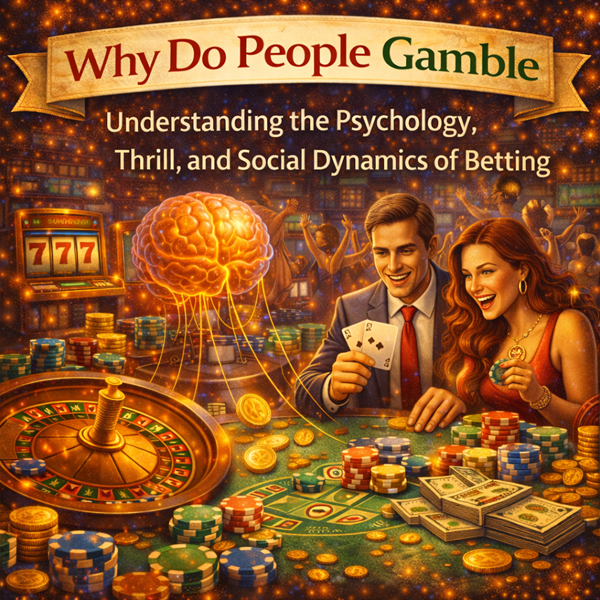
Most of us know that the house always wins in the long run, yet the global gambling industry continues to thrive as a multibillion-dollar reality. We keep playing because our choices aren’t actually driven by math, but by a powerful mix of deep-seated psychological needs and emotional highs. It is a fascinating look at the way our minds crave excitement and hope even when the odds are stacked against us.
The Thrill of the Unknown and the Brain’s Reward System
Neuroscientists have found that our brains release massive hits of dopamine during the anticipation of a win, making the suspense of the wait more rewarding than the actual result. This effect is mirrored in B.F. Skinner’s famous experiments, where he showed that like rats pressing a lever for random rewards, humans can become obsessed with the unpredictable “variable ratio reinforcement” of a game. Even a “near miss” keeps us hooked because the brain incorrectly signals that we are learning and that a victory is just around the corner.
Chasing the Dream – The Financial Motivations
When people buy a lottery ticket, they aren’t making a calculated investment but are instead purchasing a multi-day daydream of a completely different, easier life. Financial motivations range from casual entertainment that adds “skin in the game” to a desperate, last-ditch search for a lifeline during hard times. Whether it is a two-dollar fantasy or a risky side hustle, the promise of a “big score” offers a shortcut to security and freedom that few other activities can match.
The Social Connection – Gambling as a Community Experience
Gambling often serves as a “communal campfire,” where the shared risk of a craps table can turn a group of complete strangers into a high-fiving team. Rituals like a monthly home poker game use the cards as a simple vehicle for storytelling, laughter, and deepening personal friendships. Even sports betting taps into our natural tribalism, uniting friends through the collective anxiety and joy of having an emotional investment in the same game.
The Escapism Factor – Taking a Break from Reality
Casinos are masterfully designed to help us enter a “flow state,” where the outside world of bills and stress disappears into a timeless blur of lights and sound. By removing clocks and windows while using temperature-controlled, subtly scented air, these spaces detach us from reality so we can focus entirely on the game. Whether it is a physical casino floor or a smartphone app, this sensory environment allows our minds to take a temporary, immersive vacation from the pressures of daily life.
The Ego Trip – Skill, Strategy, and the Illusion of Control
Many people gravitate toward games like poker or sports betting because they offer a chance to prove their intelligence and feel like they’ve outsmarted the system. Winning provides a powerful sense of intellectual validation, making us believe that our specific strategy or knowledge has conquered the laws of probability. This “illusion of control” often tricks us into thinking our lucky routines or deep research can influence outcomes that are actually determined by random chance.
The Digital Revolution – Gambling in the Modern Era
Smartphones have removed every physical barrier to entry, transforming gambling from a destination event into a seamless activity that follows us everywhere. Modern features like micro-betting allow for high-speed rewards every few seconds, while “gamification” and “loot boxes” have blurred the lines between traditional betting and video games. This constant accessibility and high-tech design have integrated the thrill of the gamble into the very background of our daily modern lives.
Cultural and Historical Roots – A Tale as Old as Time
Humans have been rolling bone dice since ancient Mesopotamia, proving that the urge to take risks is a tradition as old as civilization itself. Historically, lotteries haven’t just been for fun; they have been used to fund massive public projects like the Great Wall of China and prestigious universities like Harvard. This deep-rooted history has turned betting into a normalized social ritual and a rite of passage that is passed down through generations across the globe.
When the Fun Stops – The Psychology of Compulsion
When a person’s dopamine system is hijacked, they may find themselves needing much higher “doses” of risk just to reach a baseline of emotional stability. This can lead to the “Gambler’s Fallacy,” where someone irrationally believes a win is “due” and starts chasing losses to erase the pain of a previous bet. In this supportive space, it is important to recognize that what started as entertainment can transform into a toxic cycle of compulsion and emotional distress.
Also for Sale
The recap provided in this post is explained more completely in an eBook. This guide provides a deeper look at the behaviors and history discussed here and is available for sale on Google Books. You can find the full version here: Why Do People Gamble?