Rigged by Design: How Online Gambling Really Makes Money
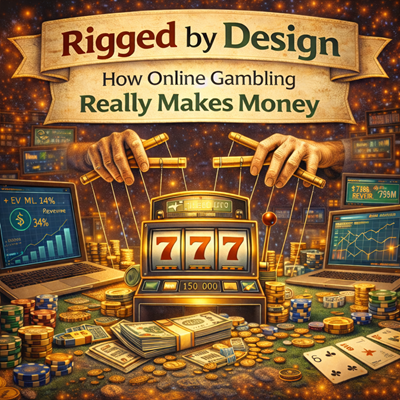
Online gambling is a meticulously engineered system of mathematics and psychology designed to guarantee operator profit through structural rigging rather than active cheating. The industry functions as a data-driven enterprise that relies on statistical certainty, behavioral economics, and cognitive hooks to extract revenue at a predictable rate. This ebook serves as a surgical dissection of the digital architecture that ensures the house always wins by design.
It Feels Random — It Isn’t
Online casinos use Pseudo-Random Number Generators (PRNGs) to simulate chance, starting with a seed value to produce a deterministic sequence of numbers. The software maps these results to a massive range of 1 to 4,294,967,296 possible numbers, where losing combinations are engineered to heavily outweigh the few winning hits. This architectural stacking ensures that a technically unbiased selection of numbers results in a perfectly engineered disadvantage for the user.
The House Edge Is Just the Surface
Most players view the house edge as a small tax on their deposit, but the math actually applies to every individual wager through a process called “churn.” As winnings are reinvested, a modest 4% theoretical edge can rapidly transform into an actual “hold” of 20% to 30% of the player’s initial funds. This mathematical grind ensures that even a player who experiences temporary winning streaks will eventually see their balance exhausted by the sheer volume of action.
Winning Is Built Into the Model
Casinos utilize engineered wins as a strategic tool for customer acquisition, treating early payouts as a necessary financial reinvestment to prevent immediate “bust out” scenarios. “Losses Disguised as Wins” (LDWs) use celebratory sensory feedback to mask payouts that are actually smaller than the original bet, tricking the brain into feeling victorious during a decline. These controlled payouts extend a player’s “Time on Device,” providing the house edge sufficient time to systematically extract the remaining balance.
Variable Rewards and Dopamine Loops
Digital gambling exploits the psychological principle of intermittent reinforcement, where unpredictable rewards trigger intense dopamine spikes in the human brain. Anticipation is heightened by the “near-miss effect,” where visual displays are specifically coded to simulate the experience of almost winning to keep the player engaged. This neurological manipulation creates a powerful compulsion to continue playing even when the mathematical reality is one of certain loss.
The Illusion of Control
Casinos foster an “illusion of control” by providing players with useless data, such as “hot” or “cold” numbers, which encourages the Gambler’s Fallacy. In games with an element of perceived skill, the player’s confidence in their own mastery often leads them to deviate from optimal strategies and place higher bets. This perceived mastery encourages longer sessions and increased risk, even though the structural rules ensure the casino maintains its mathematical dominance.
Escalation
The frictionless speed of digital play removes the natural pauses of physical reality, inducing a trance-like state where money feels like meaningless digital credits. When faced with losses, players often succumb to loss aversion and attempt to “chase” deficits by rapidly increasing their wager sizes. The online interface is specifically designed to facilitate this emotional momentum, making it dangerously easy to double bets or deposit new funds with a single click.
Bonuses Aren’t Generosity
Promotional bonuses are highly calculated mathematical tethers that use “playthrough” requirements to lock player funds into the casino’s ecosystem. For example, a $100 “gift” bound by a 30x rollover on a $200 starting balance requires $6,000 in wagering, which mathematically dictates a $300 expected loss for the player. These offers are not acts of generosity but predatory financial instruments designed to ensure the house edge exhausts a player’s balance before a withdrawal is possible.
VIP Programs and High-Value Targeting
Algorithms segment players based on deposit frequency and loss reactions to identify high-value targets for personalized, high-touch VIP treatment. VIP managers use “loss rebates” or cashback as an elegant recycling mechanism, returning a small portion of losses to ensure the player stays engaged and continues to deposit fresh capital. This recycling ensures that high-spending players remain loyal, ultimately returning the rebate and much more to the operator’s ledger.
Affiliates and Funnel Engineering
Third-party affiliates earn massive commissions by funneling high-intent traffic into the casino’s ecosystem through search-optimized blogs and review sites. These marketers are often paid via Revenue Share models, where they pocket between 20% and 40% of the lifetime net losses generated by the players they refer. Consequently, the very platforms claiming to offer “winning strategies” are financially incentivized to maximize the depth and duration of your failure.
Lifetime Value
Casinos prioritize a “slow bleed” approach to maximize a player’s Lifetime Value (LTV) rather than taking an entire bankroll in a single, unsustainable night. Data-driven interventions like targeted push notifications and free spin bonuses are used to maintain retention and keep the subject playing within an “entertainment budget.” This focus on aggregate patterns ensures that long-term revenue from a database of active players dwarfs the impact of any single, highly publicized jackpot.
Why Casinos Rarely Lose Overall
The Law of Large Numbers ensures that across millions of bets, actual results inevitably converge with the casino’s theoretical mathematical edge. While individual players experience variance, the sheer volume of daily wagers flattens these fluctuations into a predictable and unceasing flow of capital. Sportsbooks further protect their margins by using the “vig” and dynamic risk balancing to ensure they act as profitable toll booths rather than participants.
Regulation Doesn’t Change the Blueprint
While regulation prevents blatant fraud, its primary function is to legitimize the predatory blueprint by certifying that the extraction of player funds occurs according to specified mathematical odds. By verifying Return to Player (RTP) percentages, regulators codify the casino’s right to confiscate a specific portion of every wager within a legalized framework. Responsible gambling measures often serve as corporate public relations tools that shift the burden of risk onto the consumer while protecting the operator’s structural dominance.
Why Smart People Still Get Pulled In
Highly intelligent individuals often fall into an “intelligence trap” where they attempt to “solve” mathematically unsolvable algorithms through logic and analysis. This drive to outsmart the system leads to deeper engagement and an emotional refusal to admit defeat against a machine performing exactly as designed. Narrative bias further distorts reality, as players remember their wins with vivid clarity while dismissing their steady losses as temporary bad luck.
Can Anyone Beat It?
While “Advantage Play” methods like bonus hunting can theoretically gain an edge, these opportunities are fragile, labor-intensive, and rarely scalable. Online casinos use automated software to detect mathematically optimal play and will swiftly “gub” or restrict accounts that are no longer profitable to the house. The moment a player demonstrates a consistent mathematical edge, the operator exercises its right to limit bets or close the account to protect its profit model.
Seeing the Design Clearly
True detachment from gambling requires a paradigm shift where the individual recognizes the casino as an automated machine rather than a personal challenge. By deconstructing the “magic” of near-misses and VIP perks, the emotional compulsion to play is neutralized by the cold clarity of negative expected value. Recognizing that every new bet simply exposes more money to the same losing equation makes “chasing losses” appear as the irrational act it truly is.
The Final Calculation
Online gambling is a masterpiece of digital engineering that successfully merges mathematical certainty with human psychological vulnerabilities. The industry sells the illusion of opportunity while delivering the guarantee of steady mathematical decay through optimized loops and structural rigging. Ultimately, the only mathematically sound strategy to avoid this extractive system is non-participation.
Also for Sale
The complete ebook is available for sale at the following locations.