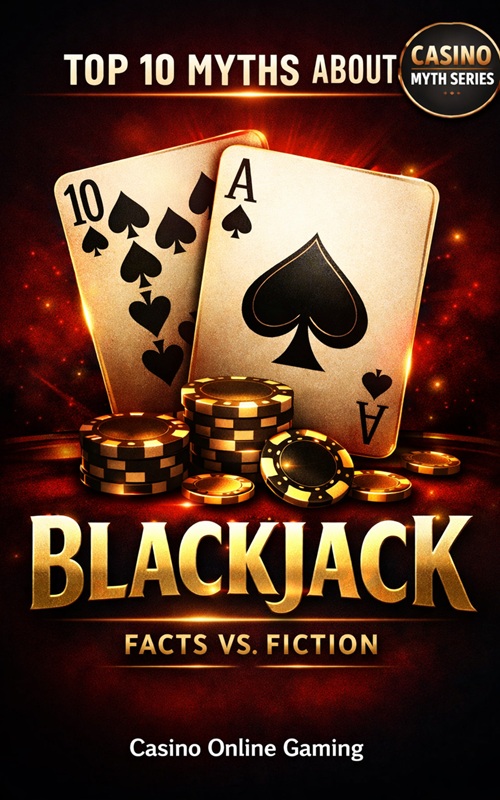
Top 10 Myths About Blackjack: Strategy, Superstition, and the Truth About the Dealer
The Reality of the Table
Walk into any pit and you’ll see players throwing away money on hunches, oblivious to the fact that blackjack is a cold, hard game of math and psychology. While the bright lights and “table energy” might suggest luck is in charge, every card dealt is actually governed by rigorous statistical averages. To survive the felt, you have to stop treating the game like a mystery and start seeing it as a series of calculated decisions.
The Dealer Always Wins
While the “house always wins” is a popular mantra, the dealer is actually a slave to the same variance that allows players to go on massive winning streaks. The casino’s real advantage is purely structural, stemming from the fact that players must act first and lose immediately upon busting even if the dealer would have followed suit. Over a single session, you aren’t fighting a dominant opponent but rather a small mathematical edge that only reveals its true face over thousands of hands.
The Last Player Controls the Dealer’s Hand
It’s easy to glare at the “third base” player when they take a card that “should” have been the dealer’s bust card, but seat position has zero impact on your long-term results. Because the deck sequence is fixed the moment the shuffle ends, any hit or stand simply shifts which pre-determined card lands in which hand. Over the course of your gambling life, these shifts balance out perfectly, proving that no one at the table can systematically sabotage the dealer’s total.
You Should Always Play Your Gut
Many players treat blackjack like a battle of intuition, but your gut is a terrible guide compared to millions of computer-simulated hands. Basic strategy identifies the optimal move for every possible scenario, and those mathematical percentages don’t care about your “feelings” or the “energy” of the room. Relying on a hunch might feel satisfying when it works, but it’s a fast track to the ATM compared to the cold, hard logic of the charts.
Insurance Is a Smart Bet
Despite the name, insurance isn’t a safety net for your hand; it’s a separate side bet with a massive house edge that functions as a drain on your bankroll. The 2:1 payout is statistically inferior to the actual odds of the dealer having a ten-value card in the hole, making it a losing proposition in standard games. Rather than protecting your chips, you are simply placing a new, high-risk wager that the casino is more than happy to book.
Always Split 10s
Seeing a pair of 10s against a weak dealer card makes many players want to “go big,” but splitting a 20 is a classic move that turns a near-certain winner into two unnecessary gambles. A total of 20 is statistically one of the strongest positions you can hold, and breaking it apart introduces risk that significantly lowers your expected value. You’re much better off standing on that powerhouse hand than chasing the drama of two new hands that will likely end up weaker.
Card Counting Guarantees Profit
Card counting isn’t a magic spell, but a way to track the ratio of 10s and Aces which, when high, increases the probability of player blackjacks and dealer busts. Even with this tracking, the edge gained is a modest 0.5% to 1.5%, which is nowhere near enough to protect you from the brutal swings of short-term variance. You might have the math on your side, but you still need a massive bankroll and nerves of steel to survive the sessions where the cards just don’t fall your way.
The Dealer Cheats
Frustrated players often suspect the dealer is cheating, but the house doesn’t need to manipulate cards when the rules already ensure long-term profitability. With constant “eye in the sky” surveillance and rigid pit boss oversight, manual interference is a risk that no sane casino would take for a few extra chips. Dealers follow scripted, procedural protocols that make them operators of a fixed system rather than opponents with the power to influence your fate.
New Decks Change the Odds
A fresh shuffle might feel like a “reset” for a cold table, but a new shoe doesn’t change the fundamental house edge dictated by the casino’s rules. While it restores the original distribution of cards and wipes away any temporary deck bias, the mathematical disadvantage you face remains exactly the same. The relief of a clean slate is entirely psychological and has no bearing on the statistical probability of the next hand dealt.
Basic Strategy Is Optional
Some gamblers think they can “wing it,” but ignoring basic strategy can immediately double the house edge from a manageable 0.5% to a 1% or higher drain on your bankroll. Every time you deviate from the mathematically optimal move, you are essentially handing the casino a larger slice of your money over time. Consistent adherence to the chart is the only way to minimize your losses and give yourself the best possible shot at walking away a winner.
You Can Read the Dealer
Unlike a poker pro, a blackjack dealer follows fixed procedural rules and has no idea what card is hiding in the shoe, making their body language completely irrelevant to the outcome. Since they don’t make choices, any “tells” or facial expressions you think you see are just human artifacts that have nothing to do with the math of the deck. Focusing on the dealer’s behavior is a distraction that won’t help you win; focus on the cards, because they are the only things that matter.
Added Information
An ebook with more details and information is available for FREE on Google Books and AudioBook. Understanding the mechanics of the game is the best way to remove confusion and approach the table with clarity. Knowledge is your only real edge when you step onto the casino floor, so make sure you’re armed with the facts before you place your next bet.