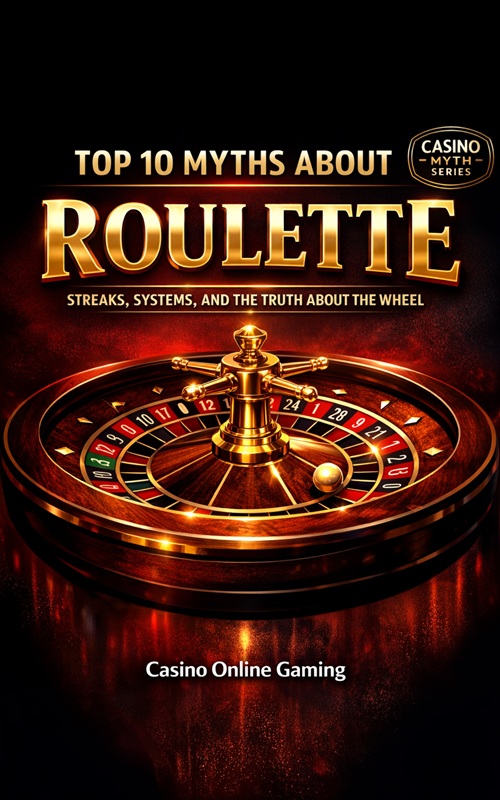
Top 10 Myths About Roulette: Streaks, Systems, and the Truth About the Wheel
Roulette is a beautiful game of physics where every single spin of the wheel is a completely independent event. It’s easy to feel like the ball has a memory or that the wood and metal are working toward a specific goal, especially during a long streak. In reality, the outcome is determined purely by the laws of motion and the chaotic bounce of the ball, with no regard for what happened just moments ago.
Red Is Due After a Black Streak
You might see eight blacks in a row and feel a heavy pull to bet on red because it seems “due” to arrive. This instinct is what we call the Gambler’s Fallacy, the mistaken belief that past results can somehow force a change in the next spin. The wheel doesn’t seek balance or fairness, and it certainly doesn’t owe you a specific color to make things right.
Each time the ball is released, the physical probability of hitting red remains exactly the same as it was on the very first spin of the night. While our brains are wired to find comfort in a return to equilibrium, the wheel has no internal mechanism to correct a streak. A long run of one color is simply a natural part of randomness and does nothing to increase the chances of the opposite color landing next.
The Wheel Remembers Previous Spins
It is tempting to look at the history board and believe the wheel is in a certain “mode” or phase based on recent outcomes. However, a roulette wheel has no memory and carries no information from one launch to the next. The only place the history of the game truly exists is on that digital display and in the minds of the players watching it.
Every spin is a fresh start where the ball and wheel interact as if they have never met before. Even if a specific section of the wheel hasn’t been hit in hours, that area isn’t “building pressure” or getting any closer to a win. The wheel does not adjust its behavior based on the past; it simply reacts to the physics of the current moment.
Betting Systems Beat Roulette
Many folks believe that by moving their chips in a specific way, they can eventually outsmart the house and walk away with a guaranteed profit. While a system might help you manage your money, it cannot change the fundamental math of the game. The house edge is a physical reality built into the green zero pockets, and it remains active on every single spin.
The truth is that the casino’s advantage applies to every dollar you wager, regardless of the pattern you use to place your bets. Systems only manage your money flow and the size of your swings, but they never remove the mathematical hurdle you are jumping over. No matter how clever the structure feels, it cannot erase the fact that the wheel is designed to favor the house in the long run.
The Martingale Guarantees Recovery
The Martingale strategy tells you to double your bet after every loss so that one single win recovers everything you’ve dropped. On paper, it sounds like an airtight safety net, but in the casino, it is a recipe for a very bad night. This system works perfectly until it doesn’t, and when it fails, it usually does so in a catastrophic way that wipes out a bankroll.
Doubling your stakes doesn’t make a win more likely; it only increases your exposure to the house edge at a dangerously fast pace. You eventually run into two hard walls: your own budget or the table’s maximum bet limit, which the casino sets specifically to stop this strategy. Relying on this method ignores the reality that long losing streaks are a normal part of the game’s variance.
Fibonacci Systems Reduce Risk
Some players prefer the Fibonacci sequence—1, 1, 2, 3, 5, 8, and so on—because it feels more scientific and grows slower than doubling. In this system, you move forward one step after a loss but must move back two steps after every win. While this slower pace might feel emotionally safer, it is still a negative progression that requires you to bet more money just to break even.
Using a famous mathematical sequence doesn’t change the physics of a spinning wheel or the odds of where the ball will land. Slower increases can still lead to uncomfortably high bets during a losing streak, and the house edge still bites into every unit you wager. The wheel doesn’t recognize human math or sequences; it only knows the probabilities of the pockets.
Patterns on the Board Predict Outcomes
Looking at the results board often makes it seem like the wheel is following a rhythm, such as alternating colors or repeating sections. This is a classic case of Pattern Recognition Bias, where our brains try to find meaningful stories in a series of random events. The display is a historical record of where the ball has been, but it is never a map of where it is going next.
Randomness naturally creates clusters and gaps that look like they have a purpose, but these shapes only appear after the results have occurred. A zigzag of colors on the screen has no power over the next spin, which starts with the same fixed probabilities as any other. Trusting the board to forecast the future is a mistake because the wheel is not trying to complete a pattern.
Switching Tables Resets Luck
When things aren’t going your way, it’s easy to feel like a specific table is “cold” and that moving across the room will change your fortune. This urge comes from a psychological trap called Reset Bias, where we believe changing our environment will somehow refresh our luck. While walking away might help your mood, the physical laws of the game remain exactly the same at every regulated wheel.
Stepping up to a new table is essentially just continuing your session at a different set of independent spins. Every wheel in a reputable casino is engineered and tested to ensure it operates with the same fixed house edge. Changing seats doesn’t alter the math of the game or the physics of the ball; it only changes the scenery.
Certain Numbers Run Hot
You might see a number hit twice in a row and hear people call it “hot,” leading them to pile chips on it in hopes of catching momentum. This is a result of Recency Bias, where we give too much weight to what just happened and ignore the long-term math. In reality, a “hot” label is just a description of the past and has no bearing on what the next spin will produce.
On a European wheel, every number has a 1-in-37 chance of hitting, while an American wheel offers a 1-in-38 chance due to the double zero. These probabilities never shift, regardless of whether a number hit five minutes ago or hasn’t shown up all night. Short-term clusters are simply a part of the game’s natural variance and do not mean a specific pocket has become a favorite.
Dealers Influence the Spin
It’s common to believe an experienced dealer can aim the ball into a specific section of the wheel through sheer physical skill. This is known as Attribution Bias, where we prefer to blame a visible person rather than a complex and chaotic mechanical system. Roulette wheels are specifically designed with “diamond” deflectors and metal separators to ensure that the ball’s path is completely unpredictable.
Even the most consistent dealer cannot account for the tiny, invisible variations in friction and air resistance that change every spin. Once the ball hits those deflectors, it enters a chaotic bounce that no human hand can control or target. The dealer initiates the motion, but the physics of the engineered equipment ensure that every result is a surprise.
Outside Bets Are Safer Long Term
Many players stick to red/black or odd/even because they win more often, which helps them avoid the pain of long losing streaks. This preference is driven by Loss Aversion, as we would rather have frequent small wins than deal with the volatility of chasing single numbers. While these bets hit more frequently, they carry the same mathematical house edge as the riskier-looking inside bets.
When you look at the Expected Value over time, the casino’s advantage remains constant whether you bet on one number or half the table. Outside bets win more often, but their low 1-to-1 payouts are mathematically balanced against their higher hit frequency. They are a great way to make your bankroll last longer, but they aren’t “safer” in terms of your long-term disadvantage.
Added Information
If you’re looking to dive even deeper into these mechanics and truly master the reality of the game, I’ve put together a full resource for you. I’m happy to share that an ebook containing even more detailed information and game analysis is currently available for FREE. You can grab your digital copy at Google Books or listen to the narrated version via this AudioBook link.